Product Type: Fixed Dock Leveler
Load Capacity: 6000kg / 8000kg / 1000kg
Standard Stroke: Upward 400 mm / Downward 300 mm (from horizontal level), adjustment range +400 / -300 mm
Typical Operating Stroke: ±300 mm
Platform Material: Steel Plate
Power Supply: 220V / 380V AC, 0.75 kW
Wall-mounted Fixed Dock Leveler
The wall-mounted fixed dock leveler is a special installation variation of the dock leveler, characterized by the following:
The main structure is mounted on the exterior wall of the warehouse or the side wall of the loading dock.
It does not occupy any floor space in front of the dock.
It is ideal for scenarios where space in front of the dock is limited or where special layout constraints exist.
Compared with the conventional pit-mounted (in-ground) fixed dock leveler, its installation and maintenance methods are distinctly different.

FAQ
Most fixed dock levelers operate on the same fundamental principle — they create a temporary "bridge" between the warehouse loading dock and the truck trailer through the coordinated action of the main deck and the front lip.
The entire operation can be broken down into three steps:
Preparation: After the truck backs into position against the dock, the leveler raises its main platform via the hydraulic system.
Bridge connection: Once the platform reaches the appropriate height, the front lip extends or flips outward and lowers gently onto the trailer floor, completing the bridge.
Loading/unloading: With the bridge in place, forklifts, pallet jacks, and other handling equipment can drive directly from the dock into the trailer to carry out efficient and safe cargo loading or unloading operations.
After the job is completed, the leveler automatically retracts to its standby position through the hydraulic system, restoring the dock to a flat surface and getting ready for the next truck.
Where different types of dock levelers vary is not in the basic process described above, but in how the lifting and bridging actions are achieved — some use hydraulic drive, others use pneumatic or mechanical spring mechanisms; some lips are telescopic, while others are hinged flip types. It is precisely these differences in drive methods and structural designs that give rise to various types of dock levelers, each suited to different installation conditions and application scenarios.
| Type | How It Works | Best For |
| Hydraulic | Powered cylinders, push-button control | High-traffic facilities needing consistent performance |
| Mechanical | Spring-assisted, manually activated, no power needed | Moderate traffic, budget-conscious, simple and durable |
| Edge-of-Dock | Mounts to dock face, no pit required | Light traffic, sites where pit installation isn't practical |
| Air-Powered | Pneumatic/air bag system, powered without hydraulics | Facilities preferring non-hydraulic powered operation |
| Vertical Storing | Stores upright when idle | Food/pharma/cold storage where cleanliness & sealing matter |
| Tri-Pivot | Three-pivot system with lay-flat lip for smooth transitions | Heavy equipment, high-frequency ops needing ultra-smooth crossings |
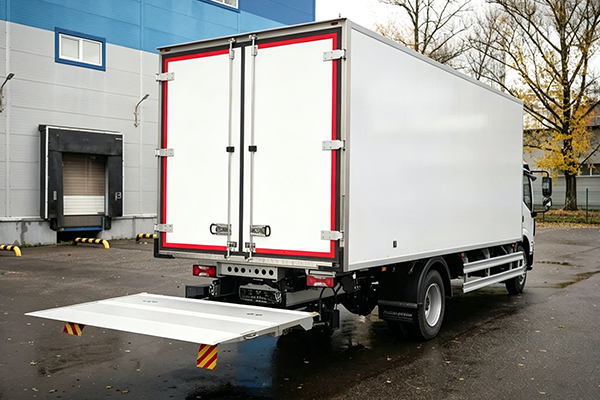
TAIL LIFT SHOWCASE